
A city where a condo and a house need different answers
Hallandale Beach is unusual in how much variety it packs into a small area. Along the oceanfront and the Intracoastal side, tall residential buildings rise above State Road A1A. A short distance inland, streets of single family houses and low rise buildings fill in around Hallandale Beach Boulevard. Gulfstream Park gives the city a landmark that people across the county recognize. For an electrician, this mix means the first question is never just what is wrong, but what kind of building you are in and who is responsible for which part of it.
A unit owner in a tower and a house owner a few blocks inland can both say that an outlet has stopped working, and yet the right response is entirely different. In a tower, the wiring inside the unit often belongs to the owner, while the risers, the main distribution and the common areas belong to the association. The owner may need approval from the board for certain work, and the work must respect rules about hours, elevators, noise and protection of common spaces. In a house, the responsibility is simpler: everything from the meter on belongs to the homeowner.
Because of this, a helpful call starts with a few plain questions. Is this a unit or a house? If it is a unit, what floor, and does the building have its own rules for contractors? If it is a house, roughly how old is it, and has the panel or wiring been changed? These questions are not formalities. The answers decide whether the job needs coordination with building management, whether a permit is handled in one way or another, and how the visit should be planned.
The people who live here are also varied. Some are full time residents who have owned for a long time. Some are seasonal and leave the unit closed for months. Some rent to others, or use the place as a second home. Each of these patterns affects what the electrical system faces. A unit that sits closed for the summer has different risks than a house in daily use, and a rental that sees frequent turnover wears outlets and switches faster than one with a single occupant.
This page is organized around those realities. The sections that follow talk about the inside of a tower unit, the older single family house, the particular effect of salt air near A1A, the demands of busy corridors and small businesses, and how to prepare for a call. If your situation falls between the categories, which is common, the same principles apply and a short conversation will sort out what fits.
Inside a tower unit: what is yours and how work gets done
In a high rise condominium, an electrical system has layers. Power arrives at the building and is distributed by large equipment to each floor. From there, a feeder enters each unit and ends at a small panel inside, often tucked in a hallway closet or a utility alcove. Everything past that panel generally serves your unit alone, and in most buildings that is the part an owner is responsible for. What lies before the panel belongs to the association, and neither you nor a contractor you hire should touch it without the building's involvement.
The panel inside a unit tends to be compact. It has a limited number of circuit spaces, and when renovations add appliances, those spaces can run out. A kitchen remodel that adds a larger oven, a wine cooler and under cabinet lighting can use more than the original panel was planned for. A careful look at the panel and the building's capacity for your unit tells you what is possible. Sometimes the answer is a small subpanel, sometimes a rearrangement of existing circuits, and sometimes a conversation with the building about the size of the feeder.
Here are some of the ways a building's rules shape electrical work:
- Many associations require notice, a certificate from the contractor, or a signed request before work begins.
- Work hours are often limited, and loud tasks may be allowed only on certain days.
- Elevators may need to be reserved and padded for moving materials.
- Shutting off power to a unit may involve the building's engineer, especially if the main disconnect is not inside the unit.
- Debris and materials must be moved through approved routes.
These rules are not obstacles, they are part of living in close quarters. A contractor who knows to ask about them at the start prevents delays.
Inside the unit, common electrical needs include adding outlets along a concrete wall, replacing old switches, adding lighting after a ceiling change, wiring a new kitchen layout and installing a dedicated circuit for a washer and dryer. Concrete construction makes a difference. Wiring is often run in surface raceways or through dropped ceiling space, because cutting into structural concrete is generally not an option. That affects how the finished work looks and what is practical, and a visit to see the actual walls is worth the time.
Worked example: an owner of a unit on a middle floor wants recessed lighting in the living room and a new outlet by the balcony door. The ceiling below is the neighbor's, so the lighting has to fit in the available ceiling space without disturbing them. The balcony door outlet needs a path through a concrete wall. After seeing the unit, the electrician proposes a slim raceway along the baseboard, shallow fixtures and a tidy cover plate, and coordinates a work window with the building office. The plan respects both the owner's wishes and the building's rules.
One more note: balconies and terraces are exposed to salt air and wind driven rain. Outlets and lights there must be rated for wet locations. Owners sometimes plug in decorative lights or a small fountain without thinking about it, so a periodic look at those connections is wise.
The older single family house on a quiet Hallandale street
Away from the oceanfront towers, Hallandale Beach has streets of houses that have been home to families for a long time. Many of these were built when electrical needs were smaller, and over the years they have been updated in pieces. For these owners, the questions feel familiar: is my panel enough, why does that breaker trip, and should I replace the wiring in the back bedroom before I remodel?
The age and construction type of the house shape the answers. A concrete block house keeps wiring in places that are harder to reach. A wood framed addition may have been built to a different standard than the original. A garage converted into living space might be fed from a modest circuit. Because each house has layers like this, the best way to understand yours is to go through it room by room and ask what was changed and when.
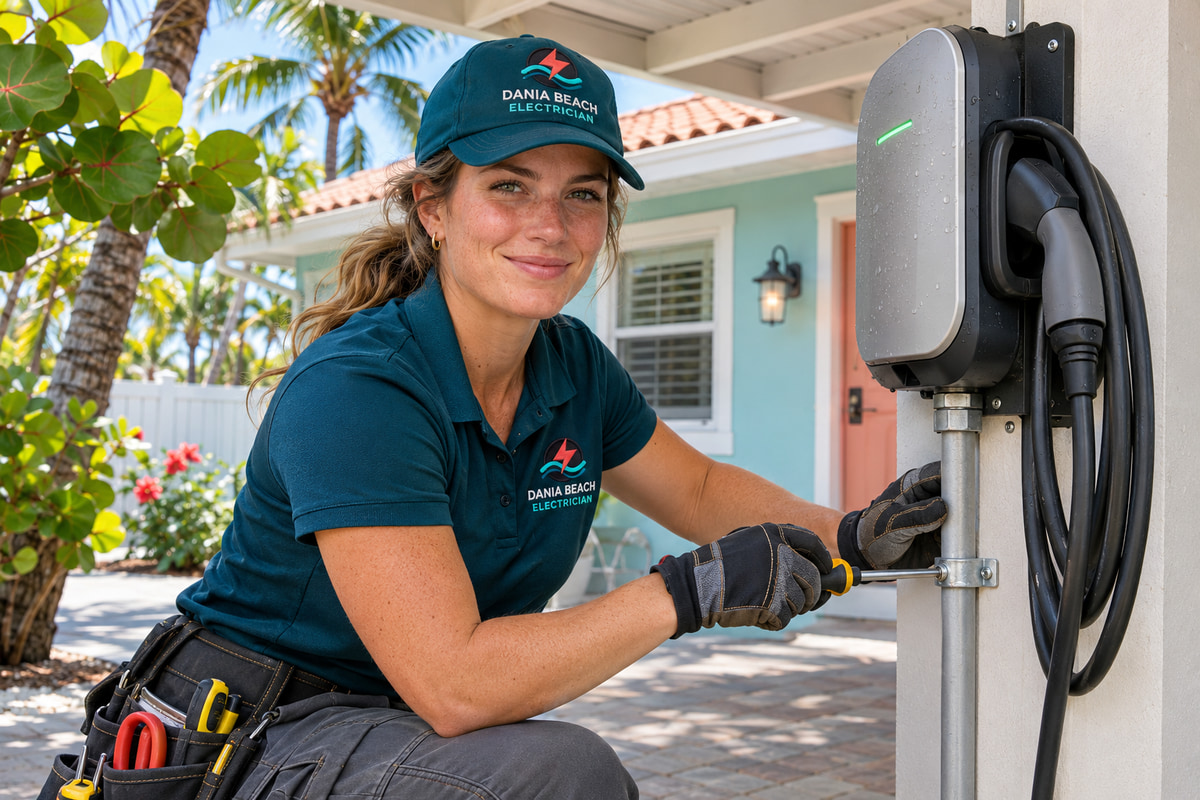
The panel again sits at the center. A house with an older panel may have limited spaces and outdated protective devices. Upgrading brings room to grow and modern protection. If you are planning a larger air conditioner, an electric vehicle charger or a pool, it makes sense to consider the panel and the service in the same conversation, so that you do not end up making the same visit twice.
Outside the house, owners often have plenty to consider. Lights over the garage, outlets on the patio, a gate opener and pool equipment are all part of daily life. In a coastal climate, these fixtures experience more corrosion than inland ones. Replacing a corroded fixture with one rated for wet locations is a small improvement with a lasting effect. A ground fault protective outlet at the patio is another simple, valuable addition.
Let us think through a possible situation. A homeowner a short drive from Hallandale Beach Boulevard calls because the living room lights flicker whenever the air conditioner starts. That points to a heavy motor load on a circuit or a loose connection somewhere. The visit would check the air conditioning circuit, the connections at the panel, and the lighting circuit. Possible findings include a loose neutral connection, an undersized wire or simply shared circuits that should be separated. The fix could be a tightened connection, a new dedicated circuit or a panel adjustment. Starting with a careful diagnosis avoids replacing parts that were never the problem.
Older houses also raise the question of smoke alarms. Alarms wired together and backed by battery provide coverage that single, aging units cannot. They need replacing on a schedule, and a visit is a good time to check their age and placement.
None of this requires panic. It requires attention, a clear explanation and a plan that fits your priorities. House owners in Hallandale Beach have the advantage of control: you decide what to update and when, and you can pace the work to suit your plans.
Salt air and the effect of living near State Road A1A
The closer you live to the ocean, the more the air itself matters. Salt carried on the breeze settles on metal and speeds corrosion. In electrical terms, this affects outdoor fixtures, enclosures, conduit fittings, screws, and the contacts inside boxes that are not tightly sealed. Properties near State Road A1A and the beach side feel this most, but the effect reaches some distance inland on windy days.
What does corrosion do? On the surface it makes things ugly: rust streaks, pitted metal, green crust at connections. Underneath, it adds resistance. A connection with corrosion has to pass current through a rough, partly insulating layer, and the extra resistance becomes heat. In a lightly loaded circuit this may never matter. In a circuit that carries a high load, such as an air conditioner or a dryer, it can lead to overheating, melted insulation and failure. Preventing corrosion is far easier than repairing the damage.
Materials make a difference. Outdoor boxes and fixtures made of corrosion resistant materials last longer than plain steel. Stainless steel hardware, sealed fittings and gaskets, coated or plastic conduit where appropriate, and proper sealant at penetrations all extend life. A visit will often include a recommendation for replacing the most exposed items first, such as the meter area fittings, the air conditioning disconnect and the exterior lights.
Air conditioning equipment deserves special attention. Outdoor condensers and their disconnects live in the open, sprayed by salt laden air and rain. The wiring and the whip that connects them may deteriorate faster than the unit itself. A check of the disconnect box for rust, water and loose connections, ahead of the hot season, can prevent a failure on the hottest day of the year.
Balconies in towers face the same exposure on a smaller scale. A light fixture or outlet on a balcony, particularly on a high floor where wind is strong, will see salt on a constant basis. Fixtures marked for wet locations and kept clean last longer. Rinsing the exterior of a fixture with clean water now and then, with the power off, helps remove salt residue.
Here are habits that reduce salt related problems:
- Look at outdoor boxes, covers and fixtures a few times a year for rust, crust or cracks.
- Replace broken weatherproof covers promptly, since a missing gasket lets water in.
- Keep sprinklers from spraying directly onto light fixtures and outlets.
- Ask for corrosion resistant materials when replacing outdoor parts.
- Test ground fault outlets and breakers monthly.
Taking these small steps keeps a coastal electrical system healthy. They are modest compared with the cost and inconvenience of a failure, and they fit naturally into the seasonal rhythm of caring for a home near the sea.
Busy corridors, shops and small businesses
Hallandale Beach Boulevard and the roads around it carry a steady flow of traffic and a mix of shops, offices, restaurants and service businesses. Close to Gulfstream Park, the area has an entertainment and visitor flavor, and the businesses nearby need dependable power. A flickering sign, a tripping breaker in the kitchen or a failing parking lot light costs a business customers and goodwill.
Commercial electrical needs resemble residential ones in spirit but differ in scale and rules. A small restaurant, for example, runs refrigeration around the clock, a hood and exhaust system, cooking equipment, lighting and often outdoor seating with power for lights and heaters. Each of these has its own requirements. Circuits for refrigeration should be dependable and clearly labeled so that staff can find them in an emergency. Equipment near water, such as dishwashers and prep sinks, needs ground fault protection.
Retail spaces care about lighting. Displays, signs and general illumination use many fixtures, and an owner who wants a refresh may be considering a change in fixture type. Replacing old fixtures with more efficient ones changes the load and the heat output in the space. An electrician can reduce wasted energy and make the room feel more comfortable for customers and staff.
Offices have their own priorities: enough outlets, reliable circuits for computers and network equipment, and lighting that reduces glare. Surge protection for sensitive equipment is wise anywhere that downtime hurts. Emergency lighting and exit signs are another subject, since they have to work during an outage and must be tested on a schedule. A property owner or manager should know who is responsible for keeping them in order.
Tenants and landlords sometimes disagree about who pays for which electrical work. A lease normally addresses it, but it helps to document problems with photos and notes, and to let the landlord know in writing. A repair done without informing the right party may cause disputes later. An electrician can describe what is wrong in plain language, which helps both sides make decisions.
Planning around business hours is a practical matter. Many electrical jobs can be arranged for early mornings, evenings or closed days so that customers are not disturbed. Power interruptions can be scheduled and announced. When a business cannot afford downtime, an on site visit lets the electrician propose a plan that keeps the doors open as much as possible.
For mixed use buildings, where apartments sit above shops, shared panels and meters add another layer. Understanding which circuits feed which space avoids confusion. A clear map, with labels and notes, is among the most valuable results of any visit to a commercial property.
Before you call: what helps and what to expect
A little preparation makes a call or visit go smoothly, whether you own a unit, a house or a small business in Hallandale Beach.
Start by collecting a few facts. For a unit, know the floor, the building's name and whether the association requires notice for contractors. For a house, know its approximate age and whether the panel or wiring has been changed. For a business, know whether you own or lease the space. Photograph the panel, the problem fixture and any labels. Write down when the problem started and what was happening at the time, such as a storm, a new appliance or a power outage.
On the phone, describe symptoms plainly. 'The kitchen outlets work but the one by the window is dead' is more useful than 'the electricity is broken.' If you smell burning, hear buzzing from the panel, or see water near electrical equipment, say so right away. Those situations call for turning off power if it is safe and keeping people away until it is checked.
A quote can often begin by phone for straightforward work. When the job is larger or the situation unclear, an on site visit is the honest route, because a number given blindly is likely to be wrong. At the visit the electrician looks, tests and listens, and then explains what was found in terms that make sense to you. You can ask about options, about what is urgent and what can wait.
If you are in a condominium, bring the building's contractor requirements to the conversation, or ask the office what they are. If work needs a permit, the permit office decides what applies, and your electrician can guide you through the steps. If the building requires insurance paperwork from contractors, ask the electrician what they can provide in advance rather than the day of the work.
After the work, keep the records. A note of what was done, the date and any warranties on parts is worth saving in a folder. Photograph the finished panel and its directory. Test any protective devices as shown, and watch for unusual behavior in the first weeks.
Residents near Hallandale Beach Boulevard, Gulfstream Park and State Road A1A come from many backgrounds and live in many kinds of buildings. What they share is the wish for electricity that simply works and is safe. If you are not sure where to start, call and describe your situation. A short conversation is usually enough to tell you whether you need a quick repair, a planned project or just a bit of reassurance.
Settings in Hallandale Beach this page speaks to
Hallandale Beach blends oceanfront towers with older neighborhoods and busy commercial roads. Common situations include the following.
- Condominium units near State Road A1A, where the owner handles wiring inside the unit and the association handles the rest.
- Single family houses a few streets from Hallandale Beach Boulevard, with panels and circuits from an earlier era.
- Balconies, terraces and outdoor fixtures exposed to salt air and driven rain.
- Small businesses near Gulfstream Park and along the boulevard that need dependable lighting, signage and refrigeration.
- Seasonal homes that sit closed for months and need a check before the owner returns.
If your situation is different, describe it by phone and the visit can be shaped to match.
Nearby places with related pages
Neighbors may also want to read the pages for Golden Isles, which covers canal front homes, and Hollywood Hills for older block houses. Our electrical panel upgrades page explains how a panel project works, and the guide on outdoor kitchens and grills before storm season helps with patio planning.